



China's "AI Plus" Initiative Accelerates Empowerment Across Myriad Industries
作者: Luo Fei 来源: Xinhua News Agency 编辑: Yang Xiaoting 时间:2025-08-31 15:21:13
Conversational humanoid robots captivated a throng of enthusiastic visitors. Elsewhere, facial recognition devices, dubbed "AI doctors," provided remote consultations and health assessment reports through eye scans. A virtual bridge, built with a digital twin, offered visitors an intuitive understanding of the precise engineering behind world-class bridges.
Recently showcased within the professional exhibition area of the China International Big Data Industry Expo 2025 (Big Data Expo 2025) in Guiyang, these tech-rich scenes clearly depicted how "AI Plus" is rapidly boosting myriad sectors.
Of the digital offerings from 375 Chinese and international exhibitors, over 60% were "AI Plus" related. This not only offered visitors a glimpse into future living but also served as a vivid testament to the nation's push for the "AI Plus" initiative and the deepening of its "Digital China" development.
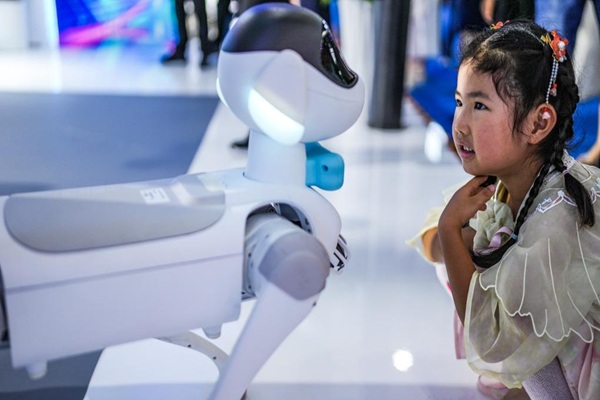
A kid is captivated by a robot dog at the China International Big Data Industry Expo 2025, which opened on August 28 in Guiyang, Guizhou. (Photo by Tao Liang / Xinhua News Agency)
iFlytek unveiled its "City Agent" conceptual solution at the Expo. "It's clear from the numerous agents and smart terminal exhibits on display, as well as the discussions among participating Chinese and international experts, that China's 'AI Plus' initiative is having an increasingly noticeable impact on areas such as consumption, production, and daily life," stated Chen Minjun, General Manager of iFlytek's Digital Government Business Unit.
According to Yu Ying, Deputy Head of the National Data Administration (NDA), the global digital economy is now transitioning into a new phase characterized by the marketization of data elements as its core and propelled by intelligent technologies.
This intelligence-driven empowering effect is particularly evident in China's primary-level governance. The recently concluded national final of the "Village Super League" brought immense popularity to Rongjiang, a small town in southwest Guizhou. However, a large influx of personal vehicles from across the nation also posed a significant challenge to local traffic.
Guizhou's traffic management authorities have developed a "Real-time Province-wide Expressway Vehicle Operations Map" by utilizing a dedicated "Province-wide Expressway Vehicle Operation Status" module. This system integrates data from expressway police checkpoints, Electronic Toll Collection (ETC) systems, and toll station ramp checkpoints, enabling the proactive prediction of traffic peaks and timely diversion of vehicles via suburban ramps, thereby effectively alleviating congestion. It is reported that this system has provided traffic support for thousands of major events across the province, significantly enhancing traffic efficiency.
As China's first national big data comprehensive pilot zone, Guizhou's smart technology application scenarios are far from limited to these examples.
Guizhou has unveiled "Huang Xiaoxi," a new smart travel assistant, to enhance convenience for tourists visiting the province this summer. "The name "Huang Xiaoxi" is derived from the province's three most iconic attractions: Huangguoshu Waterfall, Seven Small Arches Scenic Area in Libo County, and Xijiang Qianhu Miao Village. The travel assistant offers thoughtful intelligent assistance to all visitors, whether they are experienced travelers or first-timers to Guizhou," Vice Governor Luo Qiang of Guizhou explained.
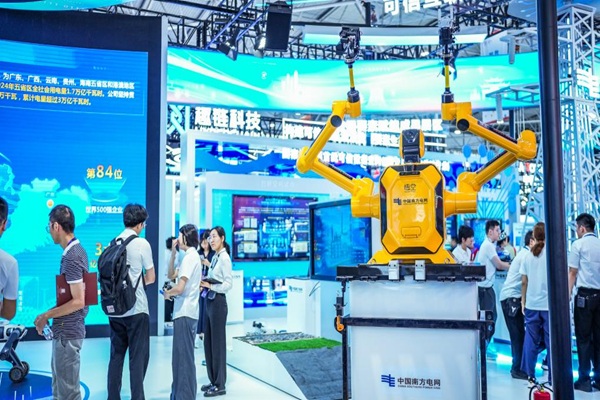
A live-line work robot is on display at the China International Big Data Industry Expo 2025, which opened on August 28 in Guiyang, Guizhou. (Photo by Tao Liang / Xinhua News Agency)
Guizhou is currently advancing the coordinated development of computing power, data, applications, and industry to continuously consolidate and expand its digital economy. A core task in this endeavor is the development of the artificial intelligence industry, with a particular focus on industry-specific large models. Luo stated, "To date, we have established nearly 100 large model application scenarios across 24 key industries throughout the province."
Nationwide, the influence of "AI Plus" is extending into more and more fields. Smart inspection robots deployed at Daqing Oilfield, for instance, are significantly boosting the efficiency of oil pipeline operations and maintenance through capabilities like high-precision oil leak detection. In Shanghai, AI education terminals offer real-time homework grading and targeted practice, leading parents to call them "AI private tutors." Similarly, the Guangzhou Municipal Government Service Center has integrated data from dozens of departments, enabling an increasing number of services to be processed online, thereby reducing the need for physical visits by citizens and allowing data to work more.
The rapid development of intelligent technologies necessitates a solid industrial foundation. China has become the world's largest holder of artificial intelligence patents, representing 60% of the global total. By the end of 2024, the country had registered 302 generative AI services, supported by 9.4 million software developers actively contributing to innovation and providing core backing for technological iteration.
In a push to advance its artificial intelligence sector, the Chinese government has, over recent years, introduced policies like the "New Generation Artificial Intelligence Development Plan" and provided dedicated financial support. The Ministry of Industry and Information Technology (MIIT) and other relevant departments have established a national artificial intelligence fund valued at 60 billion yuan, continuously channeling investment into AI-economy fusion projects. Concurrently, over 400 specialized and sophisticated "little giant" enterprises that produce new and unique products in the AI sector are quickly gaining prominence, transforming "AI empowerment" from an abstract concept into tangible, real-world changes.
Xie Shaofeng, Chief Engineer of the MIIT, stated that this year's Report on the Work of Government proposed the sustained advancement of the "AI Plus" initiative. This effort aims to better integrate digital technology with manufacturing and market strengths, thereby supporting its large-scale and widespread application.
China recently released its "Opinions on Deeply Implementing the 'AI Plus' Initiative," which outlines six major action plans for accelerated implementation. These action plan span scientific and technological advancement, industrial development, consumption upgrading, public well-being, governance capabilities, and global cooperation, thereby charting a clear course for the industry's development.
Multiple experts interviewed stated that since the beginning of this year, against a backdrop of global AI competition and cooperation, China's artificial intelligence momentum has continued to surge, rapidly empowering various economic and social sectors. Plus, China is actively participating in global AI governance, promoting pilot programs for cross-border data flow and international joint research and development. Through technology sharing and collaborative standard-setting, it is fueling global industrial upgrading and high-quality economic growth.